Agenda
Ema Mariana Pereira de Paula
Touch-feeling: Perceção Sensorial e Transformações da Materialidade na Prática do Design
Júlia Nardin
Touch-feeling: Texturas Líquidas e Design: Aceitação da Ausência da Harmonia no Material e na Perceção e Experiência do Utilizador
Gabriel Canavarro dos Santos
Teaching Without Taking Control: Onboarding Techniques in Mobile Free-to-Play Games
João Pedro Ferreira Santos
Jogar para Aprender: O Potencial Aplicado da Gamificação na Educação para a Literacia Digital
Mariana dos Santos Barbas
A Ilustração no Âmbito do Design Editorial: Um Instrumento de Ativismo e de Intervenção Social no Contexto da Imprensa Portuguesa Após o 25 de Abril (1974–2025)
Sérgio Manuel da Silva Pinto
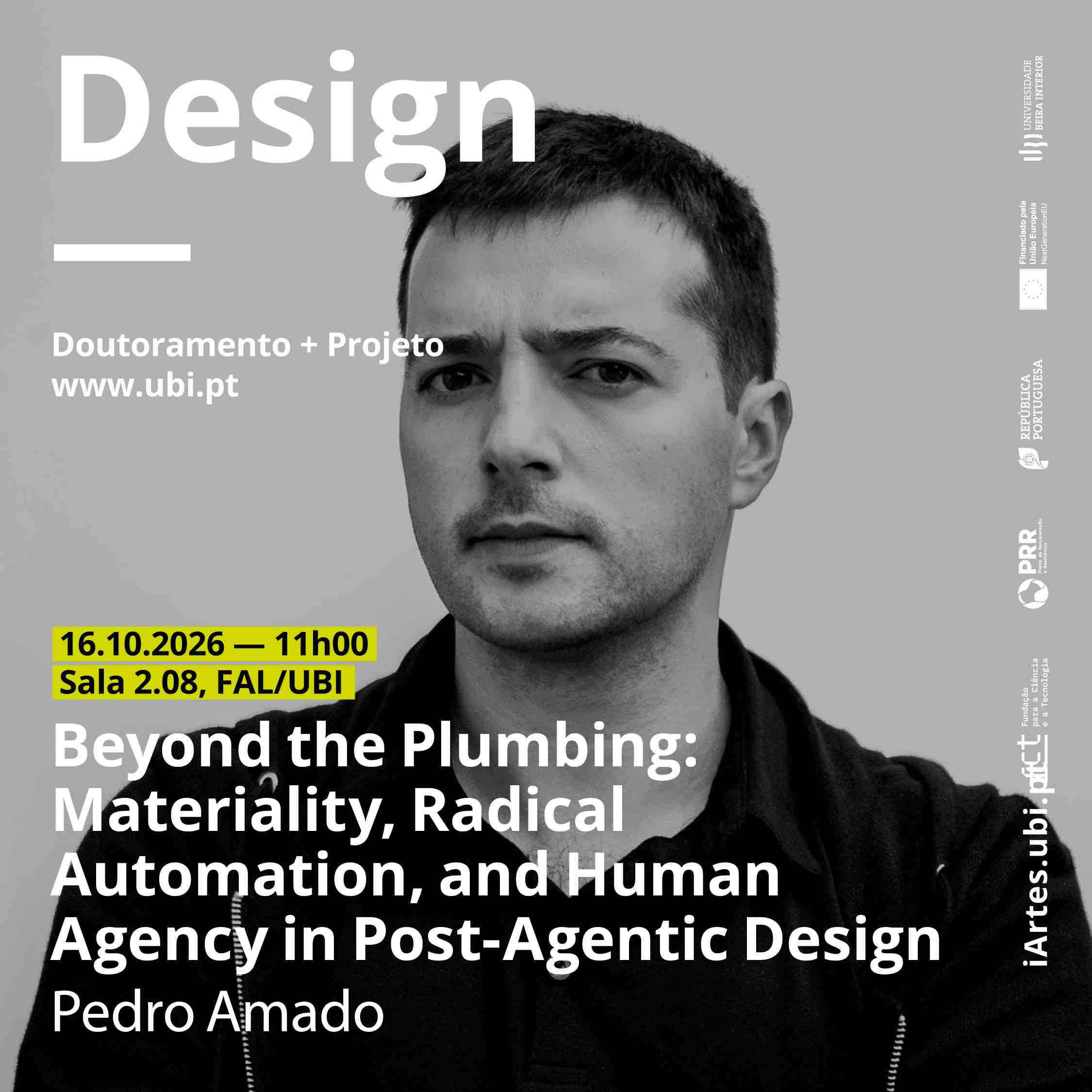
Design e Espiritualidade: A influência do Designer na Cultura Material
The OPEN DAY is open to students, researchers, and all those interested in contemporary design research and interdisciplinary approaches within the field.
Location: Sala 2.08 FAL/UBI + Zoom
Zoom link: https://zoom.us/j/93761676050?pwd=Vk2slICFygbJq7zjqfOlCRNkOpGqLb.1

Im Zentrum der Arbeit steht die Frage, welche Rolle natürliche Prozesse innerhalb gestalterischer Entscheidungen spielen können und sollten. Dabei wird davon ausgegangen, dass Gestaltung nicht ausschließlich auf menschliche Bedürfnisse ausgerichtet sein muss. Stattdessen wird sie als Teil eines Geflechts verstanden, in dem auch ökologische und materielle Prozesse wirksam sind. Diese Perspektive eröffnet die Möglichkeit, Natur nicht nur als Ressource oder Hintergrund, sondern als aktiven Faktor innerhalb gestalterischer Prozesse zu begreifen.

Vor diesem Hintergrund werden mehrere Leitfragen entwickelt: Wie kann Design heute ein verantwortungsbewusstes Verhältnis zur Natur aufbauen? Welche neuen Möglichkeiten entstehen, wenn Natur in Gestaltungsprozessen als mitwirkende Instanz betrachtet wird? Und welche Bedeutung haben dabei unterschiedliche Formen des Handelns – von aktivem Eingreifen über fürsorgliche Begleitung bis hin zum bewussten Unterlassen?
Die Arbeit setzt sich dabei auch mit historischen und aktuellen Vorstellungen vom Verhältnis des Menschen zur Natur auseinander. Es werden unter anderem Ideen der Naturbeherrschung, kulturelle Deutungen von Natur sowie gesellschaftliche Vorstellungen von Ordnung und Kontrolle untersucht.
Ergänzend wird das Projekt „Zwischenraumgarten“als praktischer Teil der Untersuchung herangezogen. Dieses von der HfG geförderte Vorhaben bietet eine niedrigschwellige Möglichkeit, sich gestalterisch mit ökologischen Fragen auseinanderzusetzen. Die entstehenden Zwischenraumgärten dienen dabei als experimentelle Orte, an denen unterschiedliche Formen des Zusammenspiels von Gestaltung und ökologischen Prozessen erprobt und beobachtet werden können.
Am 18.5. laden Simon Hanke und Tom Bieling zum Vortrags-Spaziergang mit Projektbegehung im Schlosshof der HfG Offenbach. Treffpunkt 14 Uhr, Raum 312. Eine Veranstaltung im Rahmen des Seminars “Sympoietic Design – Koexistenz entwerfen”, SoSe 2026 (Designtheorie, Bieling).
Die Masterarbeit wird betreut von Prof. Dr. Tom Bieling. Das Projekt “Zwischenraumgarten”, betreut von Prof. Dr. Tom Bieling und Susanne Wieland erfolgt als “freies Projekt” an der HfG Offenbach (2026). Es geht geht zurück auf ein, im Zuge des Projektes “Nutzen statt Besitzen” (Bieling, WiSe 24/25) entwickeltes Konzept und wird gefördert vom green.office.fondes der HfG.
]]>Ihre Arbeiten haben sich nie in Ruhe betrachten lassen. Sie haben Situationen erzeugt, in denen Betrachter nicht einfach „zusehen“, sondern positioniert werden. Wer schaut, wird mitgemeint. Wer im Kino sitzt, ist nicht neutral. Wer durch eine Ausstellung geht, steht nicht außerhalb des Geschehens. Diese einfache Verschiebung zieht sich durch ihr Werk, von frühen Aktionen bis zu späteren filmischen und installativen Arbeiten.
„Tapp- und Tastkino“ war kein cleverer Einfall, sondern eine einfache Zumutung: Öffentlichkeit wird hier nicht als Bühne verstanden, sondern als Raum, in dem Körper und Blick nicht sauber getrennt sind. „Genitalpanik“ hat diesen Gedanken nicht illustriert, sondern zugespitzt – so weit, dass viele Reaktionen eher Abwehr als Interpretation waren. Das war Teil des Punktes.

Was heute oft vergessen wird: Export hat sich nie auf die Rolle der „Skandalkünstlerin“ reduzieren lassen, obwohl genau diese Schublade früh bereitstand. Ihre Arbeiten sind keine Provokationen um der Provokation willen, sondern Versuche, die Regeln von Sichtbarkeit sichtbar zu machen. Wer darf gesehen werden, unter welchen Bedingungen, und wer bleibt dabei unsichtbar, obwohl er im Bild steht?
Dass ihre Arbeiten heute in Museen hängen, ist keine Entschärfung ihrer Fragen – aber es verändert die Situation. Aus Eingriffen in den Alltag werden Objekte der Betrachtung. Genau diese Verschiebung mitzudenken, gehört inzwischen zum Umgang mit ihrem Werk.
Ihr Tod markiert deshalb weniger einen Abschluss als einen Punkt, an dem sich die Perspektive verschiebt: von der Person zur Frage, die sie hinterlassen hat. Und diese Frage ist nicht abgeschlossen: wie Bilder Körper formen – und wie Körper sich gegen diese Formung wehren.
]]>Building on this foundation, participants engage in the practice of writing critical reviews. The process begins with a close reading of selected publications, focusing on the precise identification of their key arguments, theoretical approaches, methodologies, and conclusions. This leads to a deeper engagement with the issues and debates addressed in the texts. At the same time, the critical analysis of literature sharpens the ability to recognize the strengths and weaknesses of argumentative structures, thereby fostering the capacity to analyze and evaluate design-related, academic, and other forms of work in a differentiated manner.
By relating the reviewed works to other contributions within the field, the project generates a broader understanding of possible research contexts, connected discourses, and the resulting design perspectives and opportunities. Furthermore, it strengthens the ability to articulate complex ideas in a structured and precise way. The research project therefore serves not only to expand disciplinary knowledge, but also to develop expressive competence and critical thinking skills.

Project Group: Cindy Bournonville, Hannah Burkhardt, Emma Dabo, Anna-Christina Dritsos, Lilli Eckstein, Eva Eker, Kosmas Ftoulis, Davi Geis, Isabel Geier, Sofía Goubert, Moritz Hauenstein, Yuhan Hu, Gerrit Hülsmann, Constantin Menzel, David Paul, Marielle Rieger, Wolf Roters, Nicole Shiu Garcia, Anna Stashko, Albert Steiner, Johannes Tewelde, Viktoriia Viter, Adele Voss.
Supervision: Prof. Dr. Tom Bieling
Assistance + Layout: Susanne Wieland
Die Ausstellung ist als experimentelles Setting angelegt. Mehrere Arbeiten untersuchen, ob und wie Technologien Kommunikation oder Interaktionen zwischen unterschiedlichen Lebensformen ermöglichen können. Gleichzeitig wird thematisiert, dass technische Systeme nicht neutral sind, sondern Ressourcen verbrauchen, bestimmte Perspektiven privilegieren und ökologische Zusammenhänge nur begrenzt abbilden können.
Ein zentrales Werk ist die Installation Garden Protocol von Andreas Greiner, die für die Ausstellung entwickelt wurde. Die Arbeit verbindet Pflanzen, Menschen und technische Komponenten über Wasser als gemeinsame Ressource in einem System, das teilweise automatisiert reguliert wird. Die Installation kann als Versuchsanordnung verstanden werden, in der ökologische Prozesse und technische Steuerung miteinander verschränkt werden.
Neben den künstlerischen Arbeiten werden auch wissenschaftliche Perspektiven einbezogen. Forschende der Goethe-Universität Frankfurt bringen Beiträge aus unterschiedlichen Disziplinen ein, darunter KI-Forschung, Bioinformatik, Anthropologie sowie Kultur- und Bildungswissenschaften. Dadurch wird der thematische Rahmen der Ausstellung um wissenschaftliche Fragestellungen zu Technologie, Ökologie und gesellschaftlicher Verantwortung erweitert.
Begleitend zur Ausstellung gibt es verschiedene Vermittlungsformate wie Filmvorführungen, Workshops und Diskussionsveranstaltungen. Einige Formate richten sich explizit an ein jüngeres Publikum, etwa Workshops zu Datenanalyse oder algorithmischen Entscheidungsprozessen. Andere Programme greifen spekulative Themen wie Cyborgs oder Chimären auf, um Fragen nach den Beziehungen zwischen Menschen, Technik und anderen Lebensformen zu diskutieren.
Mit künstlerischen und wissenschaftlichen Positionen von allapopp, Baltic Raw Org (Móka Farkas & Berndt Jasper), Roland Borgards, Juliane Engel, Steven Gonzalez Monserrate, Katharina Graf, Andreas Greiner, Dženeta Hodžić, David Kuhn & Markus Rauchecker, Anne Duk Hee Jordan, Laleh Khabbazy Oskouei & Farhang Rafiee, Nadine Kolodziey, Verena Kuni, Franziska Matthäus, Xenia Snow, terra0 (Paul Kolling & Paul Seidler), Tree and Rocket, Dan Verständig, ZK/U Proxylab.
Eine Veranstaltung im Rahmen des Seminars “Sympoietic Design – Koexistenz entwerfen”, SoSe 2026 (Designtheorie, Bieling). Die Führung wird geleitet von Dr. Tim Pickartz und Susanne Wartenberg M.A.

Muss ein neuer (Hessen-)Standard zwischen Politik, Planung und Gesellschaft ausgelotet werden? Zukunftsfähiges Bauen bedeutet heute, Barrierefreiheit als essenzielle Vorsorge für eine inklusive Gesellschaft mitzudenken. Es stellt sich die zentrale Frage: Wie transformieren wir unsere vorhandene Infrastruktur in eine resiliente und für alle zugängliche Daseinsvorsorge?
Der Beauftragte der Bundesregierung für die Belange von Menschen mit Behinderungen, Jürgen Dusel, lädt daher gemeinsam mit der Bundesarchitektenkammer (BAK) und der Architekten- und Stadtplanerkammer Hessen (AKH) zur Regionalkonferenz »Inklusiv gestalten – Infrastrukturen im Bestand« ein. Impulsvorträge, die Präsentation von gelungenen Beispielen aus der Praxis sowie
Podiumsdiskussionen zeigen neue, interdisziplinäre und intelligente Planungsansätze auf.
Moderation: Katrin Müller-Hohenstein, ZDF
13.00 Uhr Registrierung und Anmeldung
14.00 Uhr Begrüßung
Gerhard Greiner, Architekt, Präsident Architekten- und Stadtplanerkammer Hessen (AKH), Wiesbaden
14.10 Uhr Grußworte
Jürgen Dusel, Beauftragter der Bundesregierung für die Belange von Menschen mit Behinderungen, Berlin
Heike Hofmann, Staatsministerin, Hessisches Ministerium für Arbeit, Integration, Jugend und Soziales, Wiesbaden
14.30 Uhr Podiumsdiskussion: Inklusiv gestalten – Infrastrukturen im Bestand
Jürgen Dusel, Beauftragter der Bundesregierung für die Belange von Menschen mit Behinderungen, Berlin
Wiebke Ahues, Architektin, Vizepräsidentin Bundesarchitektenkammer (BAK), Berlin
Prof. Dr. Tom Bieling, Lehrgebiet Designtheorie, Hochschule für Gestaltung Offenbach
Gast-Prof. Mary Dellenbaugh-Losse, Fachgebiet Sustainable Cities and Communities,
Universität Kassel
Mirko Korder, Geschäftsführer, Manager, Potenzial Pioniere GmbH, Wiesbaden
Andreas Winkel, Beauftragter der Hessischen Landesregierung für Menschen mit Behinderung, Wiesbaden
16.00 Uhr Pause
Best Practice Hessen – Soziale, grüne und graue Infrastrukturen für die Zukunft
16.30 Uhr Best Practice 1: Stadthalle Hattersheim
Volker Kilian, Architekt, HGP Architekten Leben Kilian PartG mbB, Frankfurt am Main
16.45 Uhr Best Practice 2: Freianlagen Sport- und Bildungscampus Bürstadt
Bernd Schnabel, Landschaftsarchitekt, LS2 Landschaftsarchitekten und Beratender Ingenieur Schelhorn Lukowski Schnabel PartG mbB, Darmstadt
17.00 Uhr Best Practice 3: Fuß- und Radwegebrücke Darmstadt und die unterirdische Verkehrsstation Fernbahntunnel, Frankfurt am Main
Oliver Witan, Architekt, netzwerkarchitekten GmbH, Darmstadt
17.15 Uhr Best Practice 4: Jugendherbergen Wetzlar und Marburg
Florian Duelli, Innenarchitekt, Duelli Innenarchitektur Partnerschaft, München
17.30 Uhr Reflektion
Jürgen Dusel, Beauftragter der Bundesregierung für die Belange von Menschen mit Behinderungen, Berlin
Volker Kilian, Architekt, HGP Architekten Leben Kilian PartG mbB, Frankfurt am Main
Bernd Schnabel, Landschaftsarchitekt, LS2 Landschaftsarchitekten und Beratender Ingenieur Schelhorn Lukowski Schnabel PartG mbB, Darmstadt
Oliver Witan, Architekt, netzwerkarchitekten GmbH, Darmstadt
Florian Duelli, Innenarchitekt, Duelli Innenarchitektur Partnerschaft, München
18.00 Uhr Podiumsdiskussion: Staatsziel Infrastruktur und Inklusion –
Zwischen Bürokratieabbau, Kostensteigerungen und neuen Standards
Jürgen Dusel, Beauftragter der Bundesregierung für die Belange von Menschen
mit Behinderungen, Berlin
Gerhard Greiner, Architekt, Präsident AKH, Wiesbaden
Ines Fröhlich, Staatssekretärin, Hessisches Ministerium für Wirtschaft, Energie, Verkehr,
Wohnen und ländlicher Raum, Wiesbaden
18.20 Uhr Verabschiedung
Jürgen Dusel, Beauftragter der Bundesregierung für die Belange von Menschen
mit Behinderungen, Berlin
18.25 Uhr Schlusswort
Wiebke Ahues, Architektin, Vizepräsidentin BAK, Berlin
18.30 Uhr Get Together
INKLUSIV GESTALTEN – INFRASTRUKTUREN IM BESTAND
REGIONALKONFERENZ
6 MAI 2026
STADTHALLE HATTERSHEIM, HATTERSHEIM AM MAIN
www.akh.de/inklusiv-gestalten
_Die Teilnahme an der Konferenz ist barrierearm auf Menschen mit Behinderungen ausgerichtet und wird durch Schrift- und Gebärdendolmetscher:innen begleitet.
Die Veranstaltung ist kostenfrei. Die Regionalkonferenz wird von der
Architekten- und Stadtplanerkammer Hessen mit vier Unterrichtseinheiten als Fortbildungsveranstaltung anerkannt.
_
Kooperationspartner:innen:
Beauftragter der Bundesregierung für die Belange von Menschen mit Behinderungen
Bundesarchitektenkammer
architekten- und stadtplanerkammer hessen
]]>This conceptual shift forms the foundation of the exhibition Belongings: Affection as a Design Strategy, presented at Designmuseum Danmark. The exhibition proposes a re-evaluation of how affection toward objects can be intentionally cultivated through design processes. Rather than treating emotional bonds as incidental outcomes, the curatorial framework positions them as deliberate and measurable design strategies. In doing so, the exhibition contributes to an ongoing international dialogue on how design can influence consumer behavior and encourage more responsible patterns of use.
At the core of the exhibition lies the idea that objects function as repositories of personal meaning. Everyday belongings—whether mundane or cherished—often accumulate memories, associations, and symbolic significance over time. Belongings translates this abstract notion into a participatory and experimental installation. Visitors are invited to bring a personal object and engage in an interaction that reimagines the relationship between subject and artifact. Through the integration of digital technologies, including artificial intelligence, objects are metaphorically “given a voice,” enabling participants to enter into a form of dialogue with their possessions. This performative encounter reframes objects not as passive tools, but as active participants within networks of memory, identity, and emotional exchange.

An important aspect of the exhibition is its emphasis on documentation and collective storytelling. Encounters between visitors and their objects are recorded and stored within a continuously expanding digital archive. This evolving repository functions as a shared memory space that captures diverse narratives of attachment, loss, repair, and preservation. By archiving these interactions, the exhibition highlights the temporal dimension of objects—their capacity to accumulate layers of meaning over time—and demonstrates how design processes can extend beyond production into the lived experiences of users.
Within the broader framework of contemporary design theory, “Belongings…” engages with the notion that sustainable futures depend not only on technological progress but also on cultural transformation. The exhibition suggests that affection may function as a powerful counterforce to disposability. When users form meaningful connections with their possessions, objects are more likely to remain in circulation for longer periods, thereby reducing waste and resource consumption. This perspective challenges traditional models of consumption that prioritize novelty and replacement, advocating instead for continuity, care, and repair.
Not least, the exhibition reflects the increasing role of interdisciplinary methodologies in design practice. By combining elements of installation art, digital technology, and participatory research, it positions itself as both an exhibition and an experimental laboratory. The integration of artificial intelligence not only enhances visitor engagement but also raises critical questions about the evolving relationship between digital systems and material culture. In this sense, the exhibition operates simultaneously on conceptual, technological, and emotional levels, encouraging visitors to reconsider the status of objects within their daily lives. The exhibition thus demonstrates that the longevity of objects depends not solely on their physical durability, but also on their capacity to resonate emotionally with those who use them.
Belongings: Affection as a Design Strategy is on view at the Designmuseum Danmark until 31 May 2026.
]]>Im Mittelpunkt des Wettbewerbs steht die Frage, wie Gestaltung dazu beitragen kann, Produkte, Dienstleistungen und Lebensräume für möglichst viele Menschen zugänglich und nutzbar zu machen. Gesucht werden Lösungen, die den Alltag erleichtern, Barrieren abbauen und ein inklusives Miteinander fördern – unabhängig von Alter, Herkunft oder individuellen Fähigkeiten.
Design als Schlüssel für Teilhabe
Der Staatspreis wird alle zwei Jahre vergeben und würdigt Projekte, die zeigen, wie gutes Design gesellschaftliche Herausforderungen aufgreifen kann. Dabei geht es nicht nur um ästhetische Qualität, sondern vor allem um Funktionalität, Sicherheit und Nachhaltigkeit. Auch ergonomische Aspekte sowie das sogenannte Zwei-Sinne-Prinzip – also die Nutzung mehrerer Sinneskanäle für bessere Verständlichkeit und Orientierung – spielen bei der Bewertung eine wichtige Rolle.
Einreichen lassen sich Beiträge aus unterschiedlichen Bereichen, etwa aus Architektur und Arbeitswelten, Mobilität, Gesundheit, barrierefreier Informationstechnologie, Konsumgütern oder der Gestaltung öffentlicher Räume. Neben marktreifen Produkten werden auch Konzepte und Prototypen berücksichtigt.
Neue Impulse für den Nachwuchs
Neu in der Wettbewerbsrunde 2026 ist eine Kooperation mit Hessen Design e.V. Im Rahmen eines Mentoring-Programms erhalten ausgewählte Studierende die Möglichkeit, ihre Projekte gemeinsam mit erfahrenen Expertinnen und Experten weiterzuentwickeln. Neben gestalterischen Fragen stehen dabei auch Themen wie Markenstrategie, Designmanagement sowie Material- und Technologieeinsatz im Fokus. Ziel ist es, Nachwuchstalente gezielt auf den Einstieg in den professionellen Markt vorzubereiten.
Teil eines besonderen Designjahres
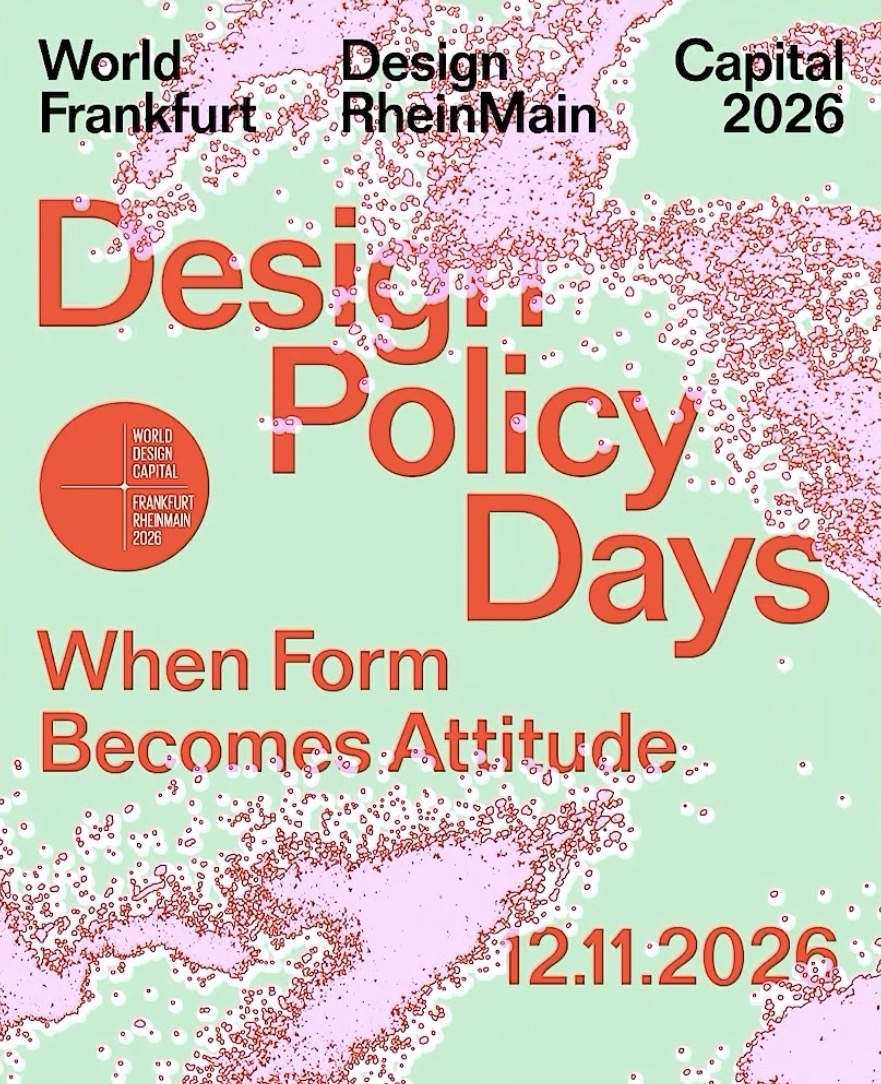
Die aktuelle Wettbewerbsrunde findet in einem für Hessen besonderen Kontext statt: Die Region Frankfurt RheinMain trägt 2026 den Titel „World Design Capital“, wodurch internationale Aufmerksamkeit auf die lokale Designszene gelenkt wird. Gleichzeitig feiert das Land Hessen sein 80-jähriges Bestehen. Der Staatspreis versteht sich in diesem Umfeld als Impulsgeber, der zeigt, wie Gestaltung aktiv zu gesellschaftlicher Teilhabe und nachhaltiger Entwicklung beitragen kann.
Auszeichnungen und Termine
Der Hessische Staatspreis Universelles Design ist ein Ehrenpreis für beispielhafte und zukunftsweisende Lösungen. In den Kategorien „Unternehmen“ und „Nachwuchs“ werden Auszeichnungen und Anerkennungen vergeben. Für den Nachwuchsbereich steht ein Preisgeld von insgesamt 7.000 Euro zur Verfügung.
Wichtige Termine im Überblick:
Bewerbungsstart: 13. April 2026
Bewerbungsschluss: 14. August 2026
Jurysitzung: 15. September 2026
Preisverleihung: 12. November 2026
Weitere Informationen zu Teilnahmebedingungen und Einreichung sind über die offizielle Wettbewerbswebsite https://universellesdesign.de oder das German Design Council abrufbar.
]]>By revisiting Ferdinand Tönnies’ distinction between Gemeinschaft and Gesellschaft (p. 23), it foregrounds the semantic ambiguity of “community,” a term that circulates widely in digital culture, branding discourse, and civic rhetoric. The compiled positions and portrayed projects respond to this ambiguity with a working definition that emphasizes belonging, participation, and sustained relationality—conditions that exceed algorithmic segmentation and resist reduction to market logic. This conceptual groundwork sets the stage for a triadic framework that runs throughout the volume: design for communities, design in communities, and design by communities (pp. 23–24). These positions do not describe discrete methods but overlapping orientations, marking different degrees of proximity and responsibility within collective processes.
The volume is structured into five thematically organized sections, each advancing the argument that design and community are mutually constitutive rather than hierarchically ordered. Across these sections, the book assembles a notably diverse set of methodological, theoretical, and practice-based contributions that span geographic, disciplinary, and political contexts.
Mapping Relations: Methods and Relational Practices
The first section, Tracing and Relational Practices, establishes methodological ground by addressing how communities become perceptible to design. Dietmar Offenhuber introduces the concept of “sensing communities,” drawing attention to collective data practices as both epistemic and social processes. His analysis contrasts digitally mediated activism—such as crisis mapping—with embodied practices like community gardening, arguing that meaningful change depends less on informational transparency than on shared material engagement and collective interpretation.
Complementing this perspective, Paul Wilson proposes “reparative diagrammatics,” a participatory mapping approach that privileges lived experience and affective knowledge over cartographic accuracy. By foregrounding fragmentation, contradiction, and narrative multiplicity, this method challenges dominant spatial representations and offers a framework for community cultural citizenship rooted in plural knowledge systems.
Seçil Uğur Yavuz extends the relational lens by conceptualizing communities as meshworks of human and non-human actors. Her focus on the mediating agency of artifacts reframes design objects as catalysts for relational repair and transformation. Rather than controlling social outcomes, design operates here as a subtle intervention within complex ecologies of care and interaction.
Territory, Mobility, and the Politics of Belonging
The second section, Territories and Belonging, interrogates spatial identity through lenses of migration, housing, and territorial imagination. Drawing on personal narrative and postcolonial theory, Torben Körschkes reflects on community formation through the notion of nationhood while invoking Édouard Glissant’s idea of the Tout-Monde to imagine fluid, post-territorial affiliations.
Mobility emerges as a central theme in Ruth Duma Coman’s study of Romanian migrants in Germany, where patterns of temporary residence destabilize conventional notions of settlement. Her work reframes community as a network of practices rather than a fixed location, urging designers to engage with translocal rhythms rather than static spatial models.
Saskia Hebert addresses housing as a foundational infrastructure of belonging. By examining cooperative models, land trusts, and collective ownership schemes, she highlights how alternative housing systems can counteract market-driven exclusion and cultivate solidarity. The chapter positions housing design as both a social and political practice that shapes access, agency, and communal continuity.
Care, Activism, and Collective Empowerment
In the third section, Care and Empowerment, design is explicitly framed as a vehicle for addressing inequality. Mariana Fonseca Braga draws on Paulo Freire’s pedagogical principles to examine collaborative design practices in Brazilian informal settlements during the COVID-19 pandemic. Her analysis foregrounds mutual learning and critiques superficial participatory frameworks that overlook structural power imbalances.
Similarly engaged with urban injustice, Bruna Ferreira Montuori documents collaborative work with the community organization Redes da Maré in Rio de Janeiro. Through the production of an annual public security bulletin, visual design becomes a strategic instrument for counter-narrative construction and policy advocacy, demonstrating how graphics can function as tools of political resistance.
Sajith Gopinath introduces play as an epistemic device in participatory research with older adults, using both analog and digital tools to facilitate dialogue around ageing. His findings position playfulness not as entertainment but as a mechanism for fostering trust and co-creation within intergenerational communities.
A related emphasis on grassroots empowerment is evident in the work of Ana Correia, Bernardo Providência, Cristina Parente, Rita Madeira, and Teresa Alves Martins, whose collaboration with the ATPD association in rural Portugal demonstrates the transformative potential of interdisciplinary engagement. Their Human Rights Academy initiative exemplifies how design methodologies can intersect with social sciences and education to address systemic marginalization.
Rituals, Governance, and Cultural Transformation
The fourth section, Rituals and Politics, shifts attention to cultural practices and institutional dynamics. Ranjit Menon offers a critical account of Kochi’s unsuccessful attempt to gain UNESCO City of Design status, revealing how bureaucratic complexity and political misalignment can undermine ambitious civic initiatives. His contribution underscores the necessity of political literacy within design practice.
Exploring ritualized responses to death, Marja Kuronen, Mari Suoheimo, Anna-Maija Ohlsson, and Jonna Häkkilä analyze contemporary Finnish funeral practices. Their systems-oriented perspective reveals how institutional traditions can both support and constrain communal mourning, suggesting opportunities for service design to reimagine collective rituals.
Nilton Gonçalves Gamba Junior concludes the section with an investigation into the evolving symbolism of masks in Rio de Janeiro. Tracing their transformation from festive artifacts to politically charged objects, he demonstrates how design artifacts mediate tensions between collective identity and state authority.
Practices, Spaces, and Experimental Communities
The final section assembles eleven projects that bridge research and practice, demonstrating how community design unfolds across diverse contexts. Jan Rosskothen examines cruising as a spatial practice that reconfigures public space and challenges heteronormative urban structures. Franziska Wissel maps the infrastructural networks supporting Frankfurt’s Japanese diaspora, illustrating how businesses and cultural institutions sustain diasporic cohesion. Olga Touloumi revisits the spatial politics of the United Nations, revealing how architectural and communicative design shaped postcolonial negotiations and alternative worldmaking.
Mert Eyit documents queer club culture as fragile yet vital infrastructures of belonging. Susanne Wieland turns attention to non-human communities, examining ecological life emerging within urban cracks. While Jonas Berger uncovers improvised design practices among incarcerated individuals, highlighting resilience within constrained environments.
Janka Csernák’s FRUSKA initiative empowers young girls through participatory maker education. Daniel Rese and Anton Viehl present radraum, a collaborative bicycle workshop that fosters
sustainable urban mobility and civic engagement. Sallar Shayegan introduces Soundhänger, a mobile sound-based infrastructure that activates public interaction. Whereas the UZUMUMBA Kiosk demonstrates participatory spatial governance through resident-led decision-making. Finally, David Martin Maurer-Laube, Zachary Mentzos, and Tom Bieling discuss their project SPEAK UP, a mobile Speakers’ Corner that revitalizes public discourse through open-source design.
Toward a Relational Design Paradigm
What might distinguish Community (&) Design from earlier compilations on participatory or social design is its insistence on relational depth rather than procedural novelty. The book repeatedly demonstrates that community engagement cannot be reduced to workshop formats or co-design toolkits. Instead, it requires sustained attention to infrastructures of trust, conflict, and negotiation.
Equally significant is the volume’s geographic breadth, spanning Europe, Latin America, and beyond. This diversity underscores the impossibility of universal design solutions while simultaneously revealing recurring patterns—particularly the centrality of care, dialogue, and shared authorship in resilient communities.

Tom Bieling, Wolfgang Jonas & Maria Cecilia Loschiavo dos Santos (2026): Community (&) Design: Material, spatial, and Social Encounters. Mimesis International. Design Meanings / Mimesis International, Milano / Sesto San Giovanni, 244 Pages
ISBN (Print): 978-88-6977-513-0
ISBN (E-Book): 978-88-6977-546-8
Serie: Design Meanings, Volume 4
“The book serves as a global handbook for designing with communities. This is the first reading when your focal points are design and communities.”
Satu Miettinen, Professor of Service Design, University of Lapland
“Strong collections like this make clear that Social Design is now well beyond the ‘good intentions’ Ivan Illich criticised. Each chapter demonstrates that you need a creative critical framework to
evaluate your designing in relation to communities.”
Cameron Tonkinwise, Professor of Design Studies, University of Technology Sydney
“This book demonstrates just how important the lived experiences of designing, enabling and sustaining communities are. Through a rich array of perspectives the authors illustrate how design has the potential to help communities thrive. It is a manual for transformation.”
Craig Martin, Personal Chair of Interdisciplinary Design Studies, The University of Edinburgh
DESIGN MEANINGS is directed by Renato Troncon and Tom Bieling.
]]>Fragen der Ressourcengerechtigkeit und Macht, der Repräsentation und gesellschaftlichen Teilhabe sind folglich untrennbar mit Prozessen medialer Vermittlung, sozialer und politischer Aushandlung und Symbolisierung verbunden. Angesichts der aktuellen technofaschistischen Regime müssen wir auch Extraktion als Gewaltform lokal und global mit proprietären technischen Infrastrukturen verbinden - im Ruhrgebiet und anderswo. Es ergeben sich dadurch neue soziale Perspektiven und Möglichkeiten intersektionaler Bündnisse, die einen anderen Blick auf postextraktive Landschaften erlauben. Erneuerbare Energietechnologien und Geoengineering stehen für Alternativen zu einer fossilen Welt, begleitet von medialen Bildern technischer, ‚grüner’ Innovation. Aber auch sie perpetuieren extraktive Regime, oft verbunden mit Auslagerungen von Risiken, Verletzbarkeiten und Konflikten, wie sie etwa am Beispiel Wasserstoff auszumachen sind.
Die Spring School MEDIEN EXTRAKTIVISMUS setzt sich im Spannungsfeld von Medienkulturwissenschaft und Aktivismus damit auseinander, wie ‚Rohstoffe’ gewonnen, genutzt, konstruiert, imaginiert und diskursiv verhandelt werden. Dabei wird die komplexe Verwobenheit von Materialität, medialer Inszenierung, Imagination und gesellschaftlicher Bedeutungszuweisung reflektiert.

Welche Bilder, Narrative und Frames prägen öffentliche Vorstellungen von Rohstoffen, Energiequellen oder nachhaltigen Alternativen? Wie wird in journalistischen, sozialen und künstlerischen Formaten die Fragilität und Dringlichkeit von Ressourcen, aber auch ihre schöpferische Kraft der Heilung und der Sorge inszeniert? Welche extraktiven Regime erzeugen algorithmische und cloudbasierte Systeme oder setzen sie fort? Wie erzählen wir die mit KI und Cloud Computing verbundenen Wasser, Landnutzungs- und Energiekonflikte? Wo können wir auch im Alltag Widerstand gegen extraktive Gewalt mobilisieren und praktizieren?
Die Spring School lädt Wissenschaftler_innen, Aktive und Journalist_innen ein, theoretische und empirische Zugänge zu Ressourcen als medienkulturelle Phänomene zu erproben. In diesem Rahmen sollen nicht nur Diskurse und Repräsentationen analysiert, sondern auch neue performative und partizipative Kommunikationsformate weitergedacht werden. Ziel ist es, wissenschaftliche Perspektiven mit klimapolitischem Handeln zu verbinden und damit neue Impulse für eine kritische Analyse von medienbedingter Extraktion zu setzen, die das öffentliche Verständnis von Nachhaltigkeit kritisch erweitert und angesichts der Dringlichkeit zu handeln, Umgänge mit der Klimakatastrophe finde.
17.–19. April 2026
KoFabrik, Bochum (Strunzstraße 5, 44791 Bochum)
Organisiert von Prof. Dr. Julia Bee, PD Dr. Gerko Egert, Dr. Julia-Lena Reinermann und Prof. Dr. Alisa Kronberger
]]>Neri ist Associate Professor für Moralphilosophie an der Universität Pisa, wo sie Medienethik lehrt. Sie ist Mitglied des Promotionsprogramms für Philosophie der Universitäten Pisa und Florenz sowie Redaktionsmitglied der Fachzeitschrift Teoria. In ihren Publikationen beschäftigt sie sich unter anderem mit der Ethik öffentlicher Kommunikation, mit Werbe- und Modeethik sowie mit den ethischen Implikationen visueller Medien und künstlicher Intelligenz. Im Zentrum ihres Buches steht die Frage, wie sich unser Verständnis von Bildern und Imagination verändert, wenn visuelle Inhalte durch künstliche Intelligenz generiert werden. Generative Modelle können heute realistisch wirkende Bilder produzieren, die nicht auf eine reale Situation zurückgehen. Dadurch wird die traditionelle Verbindung zwischen Bild und Wirklichkeit “geschwächt”. Neri argumentiert, dass diese Entwicklung eine neue ethische Reflexion über die Rolle des Bildes in der öffentlichen Kommunikation notwendig macht.
Ein besonderer Fokus liegt auf dem Einsatz visueller generativer KI in der Werbung sowie in der visuellen Informationsvermittlung. In beiden Bereichen besitzen Bilder eine starke emotionale und persuasive Wirkung. KI-generierte Bilder können diese Wirkung noch verstärken, gleichzeitig aber auch neue Risiken schaffen. Neri untersucht etwa die polarisierende Kraft bestimmter visueller Darstellungen sowie die Möglichkeit, dass algorithmisch erzeugte Bilder bestehende gesellschaftliche Vorurteile und Biases reproduzieren oder sogar verstärken.
Darüber hinaus verknüpft das Buch ethische Fragen mit aktuellen europäischen Regulierungsdebatten. Themen wie Urheberrecht, Mitautorenschaft zwischen Mensch und Maschine, Datenschutz, Verantwortung und Haftung werden aus einer normativen Perspektive diskutiert. Wer trägt Verantwortung für ein Bild, das von einem KI-System erzeugt wurde? Wie lässt sich Transparenz herstellen, wenn die Entstehungsprozesse komplexer Modelle schwer nachvollziehbar sind? Solche Fragen stehen im Zentrum der Analyse.
Ein weiterer wichtiger Aspekt ist die zunehmende Gefahr einer „simulakralen Realität“. Wenn künstlich erzeugte Bilder immer überzeugender werden, könnte die Grenze zwischen dokumentarischer Darstellung und Simulation zunehmend verschwimmen. Neri warnt vor einer möglichen „Anästhetisierung des Blicks“: Wenn visuelle Inhalte in immer größerer Menge und Perfektion produziert werden, besteht die Gefahr, dass unsere kritische Wahrnehmung abstumpft.
“Ethics and the Artificial Image” reiht sich somit ein in die aktuellen Diskurse um eine stärkere Integration (medien-) ethischer Reflexion in die Entwicklung und Nutzung von KI-Systemen. Ethik, so ein häufig vertretender Standpunkt, dürfe nicht erst nachträglich auf technologische Innovationen angewendet werden, sondern müsse bereits im Designprozess berücksichtigt werden. Nur so könne sichergestellt werden, dass technischer Fortschritt im Dienst des Menschen bleibt.

Veronica Neri (2025): Ethics and the Artificial Image – Accountability and Reliability for a New Status of the Visual. Milano: Mimesis International. ISBN (Print): 978-88-6977-500-0
]]>At the heart of this edition lies the idea that art is not merely representational but relational and interventionist. Artistic processes unfold through collaboration between creatives, makers, stakeholders, and communities, forming dynamic constellations of action. These practices are deeply embedded in specific contexts and attentive to both human and more-than-human actors, generating new possibilities for collective imagination and tangible change.
The volume opens with four invited contributions that set the conceptual tone. A reflective essay by Alastair Fuad-Luke introduces the notion of affective encounters as a driving force for societal transformation. Drawing from decades of experience in activist and collaborative design, he proposes relational wellbeing as a foundation for social impact—an approach that resonates throughout the projects presented.
Among them is the BeeTotems for RefuBees initiative by Hans Kalliwoda, where public art merges with ecological activism. Living sculptural structures create habitats for pollinators while simultaneously building bridges between refugee communities and local residents, envisioning urban environments as vital spaces for biodiversity and solidarity.
Mimi Hapig and Michael Wittmann present Habibi.Works in Greece, an intercultural workspace that fosters dignity and creative inclusion among refugees and local populations. Through collaborative making and shared authorship, the project establishes spaces where cultural exchange becomes a practice of mutual empowerment.
From a nomadic and decolonial perspective, Ivan Txaparro introduces Resonar Lab, operating between Madrid and Berlin. Integrating music, participatory design, and collective artistic action, the initiative advances ecosocial justice while strengthening community agency across diverse territories.

Following these invited contributions, the proceedings unfold into four thematic sections that collectively map an expanded field of social art and design.
Education, Inclusion and Creative Empowerment explores participatory pedagogies in schools, prisons, and urban neighborhoods. Through media such as photography, performance, natural ink printing, and modular typography, these initiatives foreground listening, mediation, and shared learning. Art becomes a vehicle for active citizenship and the co-creation of collective identities. This becomes clear, for instance in Jennifer Schubert’s contribution “Materials for Participation”, in which she discusses two case studies, focusing on how to overcome barriers with tangible designerly means.
Sustainability, Agency and Material Care gathers practices rooted in craft, biodesign, agroecology, and collaborative making. Challenging extractivist and productivist paradigms, these projects draw on local and ancestral knowledge systems. With strong ecofeminist and climate justice dimensions, they propose forms of coexistence based on care, interdependence, and respect for more-than-human life. This one includes a paper on “Crafting transitional design assemblages
for more-than-human future-making” by Craig Jeffcott, António Gorgel, Ana Margarida Ferreira and Daniel Buzzo
Participation, Place and Creative Intervention focuses on site-specific and community-based actions. Sculptures, performances, shared gardens, and interventions using found objects transform public spaces marked by inequality, abandonment, or gentrification. Here, process outweighs product, and art operates as a medium for dialogue, collective authorship, and civic imagination.
Finally, Technology, Inclusion and Situated Innovation examines the intersection of digital media, speculative design, and participatory methodologies. Immersive technologies, augmented reality, and interactive artifacts are deployed not as spectacle but as tools for empathy, accessibility, and critical reflection. By questioning boundaries between physical and digital, human and technological, these works envision inclusive and relational futures grounded in context-sensitive innovation.
Across all sections, recurring principles emerge: active participation, transdisciplinary collaboration, more-than-human agency, materiality as mediator, decolonial thinking, and situated technological development. Together, these approaches form a complex assemblage of practices oriented toward social impact—where artistic creation becomes an act of resistance, care, and transformative imagination.
Edited by António Gorgel Pinto, Paula Reaes Pinto, and Sérgio Vicente, the CROSS MEDIA ARTS 2025 proceedings stand as a testament to the power of cross-disciplinary engagement and community-rooted creativity. In times like these, this volume does not merely describe alternative futures—it demonstrates concrete ways of doing, caring, and imagining together. It thus expands the field of social art and design as a space of listening, belonging, and emancipation—where creative assemblages become engines for shared renewal.
–> Download the book for free!
]]>In this context, design research emerges as a decisive driver of sustainable mobility development. By combining analytical research with practical experimentation, it enables new planning perspectives that go beyond technical efficiency and focus on usability, accessibility, and societal impact. The third volume of the Mobility Design series builds on this understanding and translates research insights into actionable knowledge.
Conceived as a hands-on resource, the publication addresses municipalities, planners, mobility providers, and political actors who are actively shaping urban transformation processes. It brings together strategies, design approaches, and real-world examples developed through close collaboration between municipal administrations and mobility designers. These contributions illustrate how cities can actively foster intermodal, environmentally responsible mobility systems and make them tangible in everyday urban life.
The presented design principles are rooted in scientific research and consistently aligned with user needs. They offer concrete tools for planning, designing, and implementing future-oriented mobility concepts that integrate multiple modes of transport into coherent systems. The volume documents and reflects on the results of the research project InterMoDe, conducted at the Offenbach Institute for Mobility Design in cooperation with the City of Offenbach, and provides strategic guidance for the design of intermodal mobility systems that support sustainable urban development.
Authors: Heike Andersen, Hanna Bader, Andreas Blitz, Peter Eckart, Andreas Grzesiek, Amelie Ikas, Julian Schwarze, Anton Viehl and Kai Vöckler.

Mobility Design – Shaping Future Mobility. Volume 3: Transfer
144 pages, available in English and German
Jovis Verlag, Berlin. ISBN 978-3-98612-174-7
Born in 1932 in Halberstadt, a city marked by the destruction of the Second World War, Kluge grew up surrounded by the fragments of history that would later shape his imagination. Throughout his life, he remained fascinated by how personal stories intersect with larger historical forces. His films and writings rarely offered simple narratives; instead, they invited viewers and readers to reflect, question, and connect the pieces themselves.
As one of the founders of New German Cinema, Kluge helped redefine what film could be. Yet his influence extended far beyond the screen. He was also a prolific writer of short stories, an interviewer of remarkable depth, and a tireless advocate for independent media. His television projects created space for thoughtful conversations at a time when mass media often favored speed over reflection.
Those who encountered Kluge’s work often described it as demanding, but also rewarding. He believed that art should not simply entertain, but awaken thought and emotion. Even in his nineties, he remained active, continuing to write, film, and engage with new ideas — a testament to his enduring intellectual vitality.
Alexander Kluge passed away in Munich at the age of 94, marking the end of a remarkable chapter in German cultural life.
Alexander Kluge, 2020 (Foto: Martin Kraft) *
* Alexander Kluge at the reception of the State Representation of North Rhine-Westphalia in Berlin during the Berlinale, 2020. Foto: Martin Kraft (photo.martinkraft.com), Lizenz: CC BY-SA 4.0
]]>AAIP is designed as a traveling exhibition, giving students the opportunity to present their projects not only locally but on an international stage. Each edition introduces new partner institutions and new works, ensuring that the project grows continuously while promoting dialogue between art schools and museums worldwide.
The 2026 edition continues this trajectory. In Offenbach, the exhibition features works from HfG Offenbach and the University of the Arts Bremen, alongside contributions from the Kassel School of Art, the St. Lucas School of Arts Antwerp, the University of Applied Arts Vienna, and the Durban University of Technology. In addition, books from the Burg Giebichenstein University of Art and Design Halle are included as guest contributions.
A particular highlight is the involvement of the Klingspor Museum, which presents selected works, bridging the gap between academic experimentation and professional museum display. The exhibition thus traces a line from student projects to public presentation, revealing the vibrancy of contemporary artist’s books.

Opening
March 28, 2026, 6:00 PM
Program
April 1, 5:00 PM: Guided tour and presentation of selected works
April 10, 6:30 PM: Buchbar and guided tour
April 17, 6:30 PM: Buchbar and reading
April 18/19: Workshop Jan Blessing – office offset
April 25, from 7:00 PM: Night of the Museums
April 26: Closing event and free admission
Opening hours
Tue, Wed, Thu: 1:00 PM – 6:00 PM
Fri: 2:00 PM – 9:00 PM
Sat, Sun & public holidays: 11:00 AM – 6:00 PM
Mon: closed
Klingspor Museum
Herrnstraße 80
63065 Offenbach
The period between 1918 and 1933 marks a decisive phase in the history of political visual culture in Europe. During the First World War, posters were deployed on an unprecedented scale, transforming public space into a battlefield of images. Governments and political actors experimented with different modes of persuasion—from rational argument and statistical claims to emotional manipulation, stereotyping, and deliberate distortion. These strategies did not disappear with the armistice; rather, they migrated into the political struggles of the postwar years.
In the early years of the Weimar Republic, the political poster absorbed the psychological shock of defeat, revolution, and economic instability. Expressionist visual languages, fractured compositions, and exaggerated figures conveyed collective trauma and uncertainty. At the same time, posters functioned as tools of orientation in a rapidly changing media landscape, competing with newspapers, leaflets, and emerging forms of mass communication.

As political polarization intensified during the 1920s and early 1930s, the poster increasingly became a site of confrontation. Its imagery grew harsher, more reductive, and more aggressive—especially in material produced by extremist movements on both the left and the right. The street poster, designed for instant impact, proved particularly susceptible to simplification and radicalization. Violence, dehumanization, and apocalyptic narratives entered the visual vocabulary long before they were fully realized in political practice.
Under Pressure also addresses the limits of plurality. The Nazi seizure of power in 1933 marked a fundamental rupture: political posters ceased to articulate competing positions and were subsumed into a centralized system of ideological control. What had once been a contested visual arena became a univocal instrument of domination. The exhibition thus understands political posters not only as historical documents but as indicators of democratic fragility and authoritarian consolidation.
The exhibition presents political posters from the collection of Wiesbaden-based collector Maximilian Karagöz. Presented in cooperation with the Hessian State Parliament, whose parallel exhibition Political Posters 1945–1991 (18 March – 12 April 2026) extends the discussion into the postwar period, Under Pressure situates the interwar poster within a longer tradition of political image-making and its enduring relevance for contemporary visual culture.
Under Pressure – Political Posters 1918–1933
Museum Wiesbaden | 6 February – 9 August 2026
Originally initiated at the Escuela Superior de Diseño de Aragón (ESDA), Zaragoza, the Social Design Days have become a space for exchange within the DESIS community and its wider network. The 2026 edition marks the first time the event is organised at the University of Beira Interior (UBI), reinforcing the institution’s engagement with socially oriented design research and education. In full articulation with ESDA Desis Lab, this event is coordinated by the iA* Lab DES’SIDE, a member of the DESIS Network since 2025 and partner of its ‘Design from the Margins’ Work Group. The result of this institutional compromise and partnership can be seen in UBI DES’SIDE EXHIBITION at Wool Museum, Royal Veiga Factory nuclei (MUSLAN), through PhD, Master’s and Bachelor’s students’ projects.
Another central component of this edition is its plenary sessions, which bring together invited international speakers to foster dialogue on the current challenges and perspectives of social design. These sessions aim to expand the discussion beyond disciplinary boundaries, connecting design practice with broader social, cultural and territorial contexts.
Alongside the plenaries, panels and workshops explore situated design approaches and their relation to territory, local knowledge and collective well-being. In this context, the panel “Social Design and Innovation from the Mountains”highlights mountain territories as relevant contexts for examining how design can engage with place-based realities and contribute to locally grounded processes of change.

Workshop 01
Form Social Design versus Right-Wing Policies (Nicos Souleles)
Workshop 02
Reading the Place: Graphic-Semantic Map as a Tool for Social Design Intervention (Cátia Rijo & Helena Grácio)
Workshop 03
Filo: Tool for Social Resilience in Aging Rural Communities (Cátia Ascensão)
Workshop 04
Shaping Heritage, Planting the Future — Regenerative Design based on the Bisalhães Pottery (Raul Pinto)
KEYNOTES
Cecilia Casas Romero holds a Law degree from UNED, a MA in Sociology of Public and Social Policies at University of Zaragoza and has studied Artistic Photography at EAH. She currently teaches photography and social design at the Escuela Superior de Diseño de Aragón (ESDA) in Spain. She specializes in Practice and Education in Social Design with communities in vulnerable situations or at risk of social exclusion. She also applies the social uses of artistic photography and the Photovoice methodology to her work with disadvantaged communities. She coordinates ESDA’s DESIS Laboratory, which has developed its own unique programme in which more than a third of ESDA’s teachers are involved. She is working to make this social design education programme transferable to other educational environments, developing research to produce a model that serves this purpose. She organizes the ESDA DESIS Social Design Days, which bring together leading figures in social design education from around the world, including Ezio Manzini (Politecnico de Milan, Lorraine Gamman, Adam Thorpe and Francesco Mazzarella (UAL)). She co-founded along with Francesco Mazzarella (UAL) the DESIS Cluster “Design from the Margins” in which more than 20 universities from all around the word are involved. Along with Dr. Francesco M. and the Social Design Network they lead the CUMULUS Working Group DESC (Design Education for Social Change), they have delivered workshops in which more than 30 teachers from different international Design Schools have participated, to date. Her ongoing PhD research focuses on defining a model for educational institutions teaching social design to create healthy working environments (WHO, 2010).
Francesco Mazzarella is a design researcher, educator, and activist, striving to create positive social change, especially working with marginalised communities. As Reader in Design for Social Change at London College of Fashion, UAL, he explores how design activism can be used to create counter-narratives towards sustainability, in and through fashion. Francesco’s research spans design activism, textile craftsmanship, decolonising fashion, design for sustainability, social innovation, and place-making. Francesco is a member of the Design Council Expert Network, Fellow of Advance HE, Co-founder of the DESIS Cluster ‘Design from the Margins’ and of the Cumulus Working Group ‘Design Education for Social Change’.
Dr Nicos Souleles (PhD, AMCollT, FCES) is an accomplished academic and independent researcher specialising in social design education, design education, and technology-enhanced learning. He earned his PhD in Educational Research from Lancaster University, concentrating on e-learning in art and design. Dr Souleles has held various teaching and leadership roles across Australia, England, the United Arab Emirates, and Cyprus. His research interests include social design education, learning design, curriculum development, digital and multimedia design, and integrating the UN Sustainable Development Goals into higher education curricula. He leads the “Art + Design: Learning Lab – Design for Social Change,” engages in European projects focused on digital upskilling and sustainable assessment, and co-edits DISCERN, the International Journal of Design for Social Change, Sustainable Innovation, and Entrepreneurship.
Claire Pillar is a freelance editor and proofreader with degrees in History (BA), Asian Studies (MA) and Public Health (MPH). She also has diplomas in Librarianship and Marketing Communications. Until 2025, she was an associate of the Art + Design Lab: Elearning at Cyprus University of Technology. Now based in the UK, she is the copy editor for Discern, the International Journal of Design for Social Change, Sustainable Innovation, and Entrepreneurship.
Agenda
Provisional Programme
Thursday / March 19
09h00 | REGISTRATION
MUSLAN - Royal Veiga Factory nuclei
10h00 | WELCOMING SESSION
MUSLAN - Royal Veiga Factory Auditorium
Ana Paula Duarte
Rector of the University of Beira Interior
Francisco Paiva
Dean of the Faculty of Arts and Humanities, and Scientific Coordinator of iA* Arts Research
Flávio Almeida
President of the Arts Department
Rita Salvado
Director of the Wool Museum of the University of Beira Interior
Ana Margarida Ferreira
UBI DESIS V SOCIAL DESIGN DAYS Scientific Committee
Ezio Manzini
Honorary Professor at Politecnico di Milano, Chair Professor at University of the Arts London, and Distinguished Professor on Design for Social Innovation at ELISAVA, guest professor at Tongji University and Jiangnan University and founder of DESIS - International Network on Design for Social Innovation and Sustainability
11h00 | PLENARY SESSION
MUSLAN - Royal Veiga Factory Auditorium
‘Education in Social Design: Hackingfrom Inside’
Cecilia Casas Romero
ESDA DESIS LAB Coordinator, former Coordinator of ESDA DESIS SOCIAL DESIGN DAYS, Professor and Researcher / Escuela Superior de Diseño de Aragón
11h45 Coffee Break
12h00 | ROUND TABLE
MUSLAN - Royal Veiga Factory Auditorium
‘Social Design Education and Activism: Exploring Portuguese Educators’ Perspectives’
Chair: Francesco Mazzarella
Reader in Design for Social Change / London College of Fashion, UAL
Panel:
Ana Margarida Ferreira
Design Professor, iA* Arts Research Unit and founder member of DES’SIDE iA*Lab / University of Beira Interior
Graziela Sousa and Inês Veiga
Fashion and Communication Design Professors and Researchers of REDES / University of Lisbon
Paula Trigueiros and Alison Burrows
Design Professor, Inclusive Design Researcher and member of LAB2PT; Independent Researcher/ University of Minho
Teresa Franqueira
Design Professor, Coordinator of the ID+ DESIS Lab and former International Coordinator of the DESIS Network / University of Aveiro
13h00 Lunch
14h30 | PLENARY SESSION
MUSLAN - Royal Veiga Factory Auditorium
‘Designing from the Margins’
Francesco Mazzarella
Reader in Design for Social Change / London College of Fashion, UAL
15h15 Coffee Break
15h30 | WORKSHOP
Workshop 01
MUSLAN - Textile Workshop
(90 minutes)
´Social Design versus Right-Wing Policies’
Nicos Souleles
Independent researcher and Co-Editor in Chief, DISCERN, the International Journal of Design for Social Change, Sustainable Innovation, and Entrepreneurship, Greece
17h30 I UBI DES’SIDE EXHIBITION OPENING
Wool Museum - Royal Veiga Factory nuclei
19h30 Dinner
Paço 100 Pressa
Friday / March 20
10h00 | PLENARY SESSION
MUSLAN - Royal Veiga Factory Auditorium
’The social design challenges of putting together and editing the online journal ‘DISCERN, the International Journal of Design for Social Change, Sustainable Innovation, and Entrepreneurship’
Nicos Souleles
Independent researcher and Co-Editor in Chief, DISCERN, the International Journal of Design for Social Change, Sustainable Innovation, and Entrepreneurship, Greece
Claire Pillar
Freelance editor and proofreader and DISCERN copy-editor, UK
10h45 Coffee Break
11h00 | PRESENTATIONS + WORKSHOP
MUSLAN - Royal Veiga Factory Auditorium
‘Social Design and Innovation from the Mountains’
// Futures Cartographies Observatory: Design for Social Innovation in Peripheral Territories
Aline Moreira Monçores
iA* Arts Research Unit / University of Beira Interior, Portugal
Cláudia Alquezar Facca
iA* Arts Research Unit / University of Beira Interior, Portugal
// Agroecological Imaginaries: Co-Designing Peasant Technologies and Food Sovereignty through Participatory Research and Alternative Narratives
Susana Paixão-Barradas
Kedge Art School / Kedge Business School, Marseille, France
Marie Julie Cartoir-Brisson
Department of Communication, Culture and Language / Audencia Nantes, France
// Human-centered Design Concept: A cultural sustainable strategy in addressing the wide spread redundancy of the ‘white wedding gown’ in the Ghanaian marriage culture
Haruna Ibrahim
Department of Fashion Design and Textiles Education / University of Skills Training and Entrepreneurial Development, Ghana
// Emergency Design in Low Density Territories
Mónica Romãozinho
iA* Arts Research Unit and DES’SIDE Coordinator / University of Beira Interior, Portugal
Joana Casteleiro
iA* Arts Research Unit and DES’SIDE member / University of Beira Interior, Portugal
// The ‘Future of our Villages’ Project. Participatory speculative co-design with communities
Hernâni Alves
iA* Arts Research Unit and DES’SIDE collaborator / University of Beira Interior, Portugal
Eduardo Gonçalves
iA* Arts Research Unit and DES’SIDE member / University of Beira Interior, Portugal
Ana Margarida Ferreira
iA* Arts Research Unit and DES’SIDE member / University of Beira Interior, Portugal
// Designing Responsible Consumption: From Everyday Practice to Social Innovation
Rafaela Norogrando
CIAUD-UBI / University of Beira Interior, Portugal
Caroline Loss
CIAUD-UBI / University of Beira Interior, Portugal
Miriam Reis
ID+ / University of Aveiro, Portugal
// Weaving Memories: A Methodology for a Participatory Iterative project
Soraia Maduro
iA* Arts Research Unit and DES’SIDE collaborator / University of Beira Interior, Portugal
Mónica Romãozinho
iA* Arts Research Unit and DES’SIDE Coordinator / University of Beira Interior, Portugal
// The ‘Nós Vamos’ Project
Laura Reis
Industrial Design Master / University of Beira Interior, Portugal
Inês Gonçalves
Industrial Design Master / University of Beira Interior, Portugal
Paulo Freire
Industrial Design Master / University of Beira Interior, Portugal
Workshop 02
MUSLAN - Cafeteria Space
(120 minutes)
‘Reading the Place: Graphic-Semantic Map as a Tool for Social Design Intervention’
Cátia Rijo
iA* Arts Research Unit / Escola Superior de Educação de Lisboa do IPL, Portugal
Helena Grácio
iA* Arts Research Unit / Escola Superior de Educação de Lisboa do IPL, Portugal
13h00 Lunch
14h30 | WORKSHOPS
Workshop 03
MUSLAN - Textile Workshop
(60 minutes)
‘Filo: Tool for Social Resilience in Aging Rural Communities’
Cátia Ascensão
University of Coimbra, Portugal
Workshop 04
MUSLAN – Cafeteria Space
(90 minutes)
Shaping Heritage, Planting the Future — Regenerative Design based on the Bisalhães Pottery’
Raul Pinto
University of Trás-os-Montes and Alto Douro, Portugal
16h00 I CLOSING SESSION
MUSLAN - Royal Veiga Factory Auditorium
Ralitsa Diana Debrah
Coordinator of Design for Social Innovation and Sustainability Network (DESIS), Design Professor and Researcher / Kwame Nkrumah University of Science and Technology, Ghana, and Cape Peninsula University of Technology, South Africa
Ana Margarida Ferreira
Design Professor, iA* Arts Research Unit and founder member of DES’SIDE iA*Lab / University of Beira Interior, Portugal
16h15 Coffee Break
16h30 I GUIDED VISIT TO WOOL MUSEUM
MUSLAN - Royal Veiga Factory
Committees
Scientific Committee
UBI iA*Lab DES’SIDE and DESIS Network
‘Design from the Margins’ Working Group
Ana Margarida Ferreira
Cecilia Casas Romero
Cláudia Facca
Eduardo Gonçalves
Francesco Mazzarella
Joana Casteleiro
Júlio Londrim
Mónica Romãozinho
Nicos Souleles
Ralitsa Debrah
Susan Melsop
Teresa Franqueira
Executive Direction
Ana Margarida Ferreira
Cecilia Casas Romero
Joana Casteleiro
Mónica Romãozinho
Executive Committee
Ana Farias
Cláudia Facca
Eduardo Gonçalves
Estrela Nunes
Fátima Veríssimo
Hernâni Alves
Inês Camaño Garcia
Luís Ginja
Natacha Pinto
Pedro Fernandes Oliveira
Soraia Maduro
Tabata Aviles Parra
Exhibition Curatorship
Ana Margarida Ferreira
Joana Casteleiro
Mónica Romãozinho
Graphic Design
Fátima Veríssimo
Natacha Pinto
Institutional Support
iA* - Arts Research Unit
MUSLAN - Wool Museum
Department of Arts
PhD Program in Design
UBI DESIS 5th Social Design Days
When: 19 MAR
Where: MUSLAN / UBI
]]>Against this background, the 70th International Children’s Book Exhibition at the Klingspor Museum gains particular relevance. Its finissage (Sunday, 15 March) functioned less as a formal closing event than as a condensed journey through time: seven decades of picture-book history presented across the museum’s galleries—from the post-war period to the present day. Moving through the exhibition meant moving along a cultural timeline in which not only aesthetic developments but also broader social transformations could be traced.
To mark the anniversary, the museum (continuing its annual tradition) presented around 150 carefully selected new publications from different countries. At the same time, the exhibition invited visitors to look back: to classics, unusual or curious examples, and books that today appear almost as cultural documents. During the finissage tour, the curators Dorothee Ader and Stephanie Ehret-Pohl guided visitors through this history of the picture book. They referred to well-known classics, such as works by Janosch or Leo Lionni, but also introduced new and sometimes still little-known publications, including titles from outside the German-speaking world. This international perspective highlighted the diversity and experimental spirit that characterise contemporary children’s books.
Representing seventy years of publishing history, however, means more than simply tracing stylistic developments. Certainly, the exhibition made visible various graphic trends and aesthetic shifts, changes in illustration or typographic styles, and different approaches in book design.
Dr. Dorothee Ader (centre) gives a guided tour of the exhibition
At the same time, children’s books clearly function as mirrors of their societies. The themes they address often reveal what concerns a particular historical moment. In the 1950s, books frequently depicted an idealised world with clearly defined social roles and moral certainties. From the 1970s onward, however, the thematic spectrum expanded significantly. Progressive publishers began to introduce more critical perspectives, acknowledging children’s experiences and addressing social issues more directly.
Across the decades, shifting thematic priorities become visible: education, equality, identity, role models, the environment, politics, war, or migration. Children’s books translate complex societal debates into narratives accessible to young readers, offering ways of understanding the world through a child’s perspective. In recent years especially, emancipatory movements have left a strong imprint on children’s publishing. Traditional role models are increasingly questioned, diversity is more widely represented, and many books encourage children to appreciate their bodies, identities, and individual abilities.
Beyond themes and imagery, the books also reflect technological developments. Advances in printing processes, digital illustration tools, and layout software have profoundly changed how picture books are produced. Techniques such as digital cutting and digital image editing now expand the creative possibilities for illustrators, designers and publishers. These technological shifts also influence the visual language of contemporary books.
The direct juxtaposition of older and newer works made it particularly clear how much the picture book has evolved over time, and yet how vibrant the form remains. Between classics, curious historical examples, and recent international publications, the exhibition ultimately presented a panorama showing that the children’s book is far more than children’s entertainment. It is a cultural archive and a sensitive seismograph of social change.
]]>Die fortschreitende Digitalisierung verändert die Bedingungen kultureller Teilhabe grundlegend. Für Menschen mit Behinderungen eröffnen sich dadurch neue Zugänge, Ausdrucksformen und Möglichkeiten der Selbstbestimmung. Zugleich entstehen neue Barrieren, Normierungen und Formen des Ausschlusses. Die Tagung nimmt diese Spannungsfelder in den Blick und fragt danach, wie kulturelle Teilhabe im digitalen Wandel gerecht, zugänglich und vielfältig gestaltet werden kann.
Aus ethischer, ästhetischer und praktischer Perspektive bringt die Veranstaltung wissenschaftliche, künstlerische und aktivistische Wissensformen miteinander ins Gespräch. Ziel ist es, Räume für Austausch, kritische Reflexion und gemeinsame Praxis zu eröffnen. Das Programm umfasst Vorträge, künstlerische Beiträge, Workshops und partizipative Formate zu Themen wie Universellem Design, inklusiver Gestaltung, rechtlichen und politischen Rahmenbedingungen sowie medien- und technologiebezogenen Fragestellungen.
Die Tagung richtet sich an Forschende, Studierende, Kulturschaffende, Menschen mit Behinderungen, Vertreter:innen aus Politik, Verwaltung und Zivilgesellschaft sowie an eine interessierte Öffentlichkeit.

Programm
Mittwoch, 18. März 2026
bis 12:00 Uhr
Anreise, Registrierung, Kaffee
12:15 Uhr
Begrüßung und Einführung
Vorstellung des Programms und der barrierefreien Formate
12:45 Uhr
Pause
Erstes Panel: Theoretische Zugänge – Was heißt kulturelle Teilhabe im digitalen Wandel?
13:00 Uhr
Digitale Transformation, Teilhabe und gutes Leben von Menschen mit Behinderung
Katja Stoppenbrink (München)
14:00 Uhr
Kann der digitale Wandel die Teilhabe von Menschen mit Behinderung fördern? Eine philosophische Reflexion
Martin Hoffmann (Münster)
15:00 Uhr
Kaffeepause
Zweites Panel: Rechtliche und ethische Dimensionen des Zugangs
15:30 Uhr
Gleichberechtigte kulturelle Teilhabe aus juristischer Perspektive: rechtliche Verpflichtungen zur Barrierefreiheit im deutschen Recht
Karoline Riegel (Kassel)
16:30 Uhr
Ethik, Leichte Sprache und Teilhabe. Ein Dilemma am Beispiel der ethischen Fallbesprechung
Toni Loh (Bonn/Rhein-Sieg)
17:30 Uhr
Kaffeepause
18:00 Uhr
Performance/Workshop
A taste of access
Eine Kurzrecherche von Khadidiatou Bangoura und Yasha Müller
Ort: Studiobühne im Philosophikum, Domplatz 23, EG
Khadidiatou Bangoura und Yasha Müller (Köln) experimentieren mit künstlerischen Ausdrucksformen und sensorischen Mitteln als Zugänge, Bindeglieder und Rahmen in Tanz und Theater.
20:00 Uhr
Abendessen
Donnerstag, 19. März 2026
Drittes Panel: Universal Design und inklusive Gestaltung
09:00 Uhr
Politiken des Zugangs – Inklusion als Entwurf
Tom Bieling (Hfg Offenbach)
10:00 Uhr
Die ganze Gesellschaft im Blick – ein effektvolles Tool für einen neuen Designansatz
Jolanta Paliszewska (Berlin)
11:00 Uhr
Kaffeepause
Viertes Panel: Medien, Technologie und Disability Studies
11:30 Uhr
Creative Access: Künstlerische Praktiken und Übersetzungen des Sensorischen durch digitale Zugänglichkeit
Robert Stock (Berlin)
12:30 Uhr
Das auditive Lesen der gesprochenen Schrift. Zum Umgang mit Stimmsynthesen von Screenreadern
Miklas Schulz (Hildesheim)
13:30 Uhr
Mittagspause
Fünftes Panel: Dramaturgien von Zugang und Barrierefreiheit
15:00 Uhr
Vielsinnliche Improvisation als künstlerische Forschungspraxis
Gunda Schröder (Hamburg)
16:00 Uhr
Ästhetiken der Barrierefreiheit am Beispiel von durch 3D-Druck erstellten Tastmodellen
Lilian Korner (Frankfurt am Main)
17:00 Uhr
Kaffeepause
17:30 Uhr
Podiumsdiskussion:
Vereinfachte Zugänge zu Literatur im digitalen Wandel. Perspektiven aus dem Literaturbetrieb
Ralf Beekveldt (Spaß am Lesen Verlag)
Natalie Dedreux (Leserin)
Anne Leichtfuss (Übersetzerin)
Andreas Stobbe (aibo Verlag)
19:30 Uhr
Wine & Cheese
Freitag, 20. März 2026
Sechstes Panel: Kooperative Strategien – Theorie und Praxis kollektiver Kunstproduktion
09:00 Uhr
Generative KI und Kunst als soziale Praxis
Luise Müller (Berlin)
10:00 Uhr
Im gemeinsamen Handeln … wachsen
Irene Hohenbüchler (Münster)
11:00 Uhr
Kaffeepause
Siebtes Panel: Kulturelle Teilhabe und Disability Studies
11:30 Uhr
Aesthetics of Access aus Perspektive freier Kulturproduktion
Lisette Reuter (Köln)
12:30 Uhr
Disability Culture und Disability Arts: Rezeptive und produktive Momente der Partizipation
Siegfried Saerberg (Münster)
13:30 Uhr
Gemeinsames Resümee und Verabschiedung mit kleinem Imbiss
Wissenschaftliche Leitung:
Hauke Behrendt, Annette Gilbert, Thomas Kater und Siegfried Saerberg
Ort: Uni Münster, Seminarraum KTh I, Johannisstraße 8–10, 48143 Münster
]]>